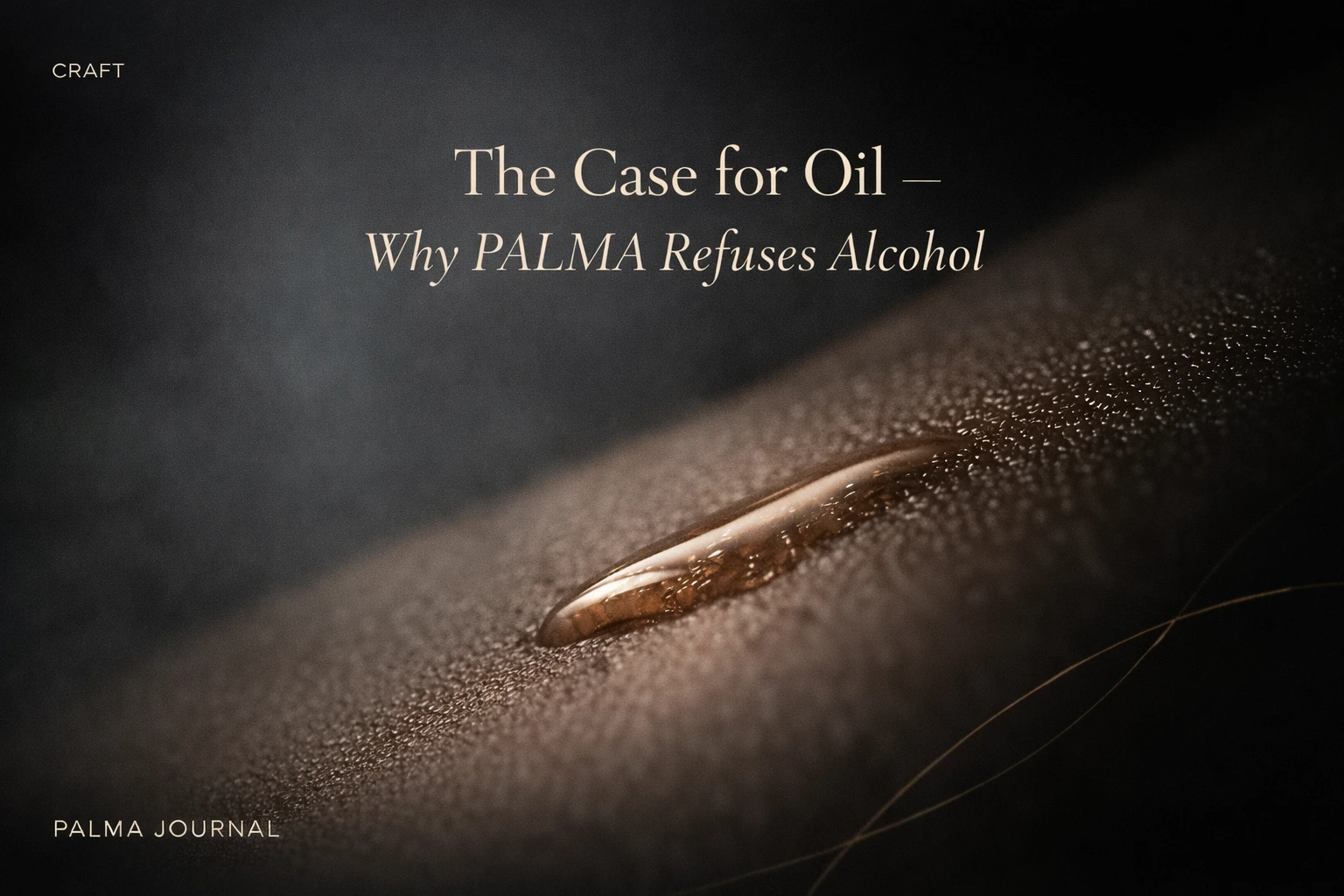
The Case for Oil — Why PALMA Refuses Alcohol
Most fragrance houses begin with a question like: “How can we make this louder?”
PALMA begins with a different one: “How can we make this truer?”
That choice changes everything—especially the base.
We are an oil house on purpose. Not as a trend. Not as a gimmick. As a discipline.
Alcohol performs. Oil lives.
Alcohol-based perfume enters the room before you do. It opens fast, bright, and dramatic—then moves quickly through its phases.
Oil doesn’t behave like that.
Oil doesn’t rush. It doesn’t throw itself outward. It settles into skin, warms with you, and becomes part of your presence rather than an announcement.
Alcohol performs in the air. Oil lives on the body.
And PALMA has always been built for the body.
Oil forces honesty
Here is the part most people don’t say out loud:
Oil is unforgiving.
There is no “alcohol sparkle” to distract from a rough edge. No sharp lift to make a blend feel finished when it isn’t. No quick diffusion to hide imbalance behind projection.
If a note is wrong, it sits there. If a blend is lazy, it stays lazy.
Oil requires precision. It demands restraint. It rewards mastery.
Which is why we chose it.
We didn’t want a base that could rescue us. We wanted a base that would expose us—so we could only ship what deserves to exist.
Longevity isn’t the goal. Presence is.
Oil lasts. That’s true. But longevity was never the headline.
Because lasting without meaning is just persistence.
PALMA is not obsessed with “hours.” We’re obsessed with presence—the kind that doesn’t need to dominate.
Oil helps us create that.
It keeps the fragrance near. It makes the experience more intimate. It turns scent into something personal, not performative.
A quiet signature, not a broadcast.
Oil changes the way you wear scent
An alcohol fragrance can feel like a layer you put on top of yourself.
Oil feels like a conversation with your own skin.
You notice it differently:
- It warms slowly instead of opening instantly.
- It shifts with your day instead of racing through it.
- It stays close enough that you catch it in small moments—when you move, when you lean in, when you forget it’s there until it returns.
Oil teaches you a different relationship with scent.
Less about being noticed. More about being remembered.
Why we call it extrait
“Extrait” isn’t just a word to sound expensive. It’s a promise about concentration and intent.
In an oil-based format, concentration matters in a specific way: not for loudness, but for richness—depth, texture, and detail.
This is why PALMA fragrances don’t feel thin. They feel deliberate.
Like the difference between:
- a bright light in your face and
- a candle you keep close.
What oil says about the kind of house we are
Choosing oil is choosing a philosophy:
- We prefer intimacy over attention.
- We prefer discipline over excess.
- We prefer scent that stays with you, not scent that tries to lead you.
Oil doesn’t just hold fragrance. It holds intention.
And that’s what PALMA is made of.
In closing
Alcohol-based perfume can be beautiful. But it is not our language.
PALMA speaks softly by design.
Oil helps us keep that promise: Every Drop, A Whisper.
If you’re curious, don’t try to “test” this like a normal perfume. Wear it once on a quiet day—on the wrist, on the collarbone—and pay attention to the moments when it returns without warning. That’s where PALMA lives.